Choosing the right Yoya Leggings manufacturer takes more than comparing unit prices. Global buyers need dependable quality, clear communication, and production capacity that matches real demand. In 2026, sourcing decisions also depend on fabric performance, order flexibility, and delivery planning. Small details matter. A waistband that rolls during movement or seams that irritate skin can turn a promising sample into a costly problem.
This guide introduces manufacturers for buyers assessing Yoya Leggings production options. It highlights practical questions about fabric composition, sizing consistency, stitching, customization, minimum order quantities, and sample approval. Buyers should request measurable specifications and review samples under realistic conditions, including washing and repeated wear. Ask how factories handle defects and production changes, too. Clear answers are useful evidence, though they are not a substitute for independent checks.
There is no universal best supplier. A startup may value low minimums and responsive sampling, while an established retailer may prioritize repeatability and larger output. Compare lead times, quality-control processes, and communication before making commitments. Verify claims with documentation where possible, and confirm that quoted terms cover the details that matter to your business. This takes time. It can still be imperfect: samples may not represent every production batch, and forecasts can change. A careful shortlist gives global buyers a stronger basis for choosing a Yoya Leggings partner, without treating marketing promises as proof.
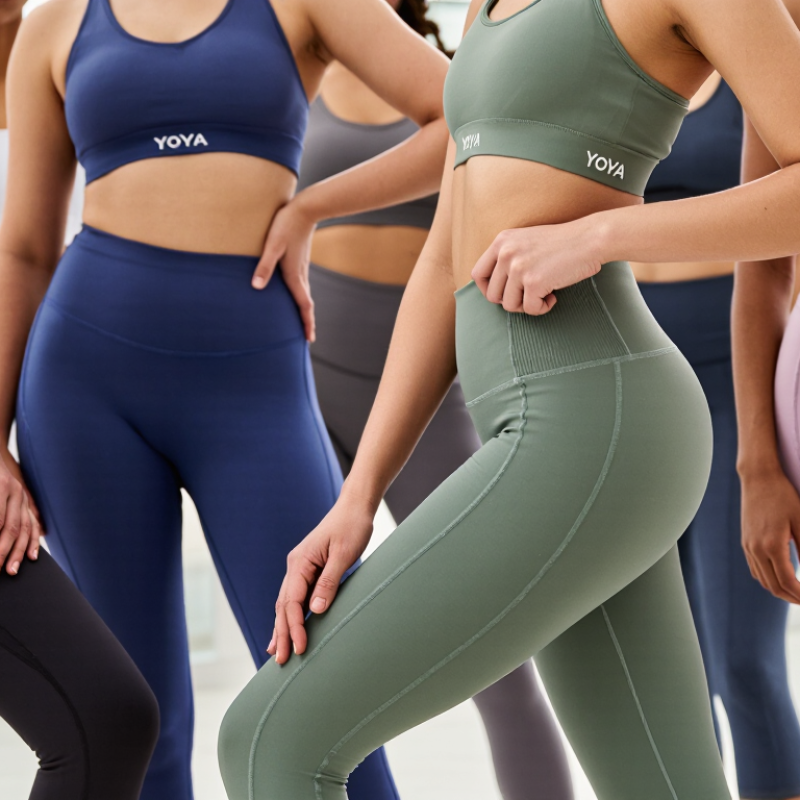
For yoga leggings, 200–300 GSM is a practical fabric-weight range, not a guarantee of quality. Around 200 GSM can feel light and breathable during warm studio sessions. Near 300 GSM, fabric usually feels more substantial and may offer greater coverage. Numbers need context. Knit structure, yarn choice, and finishing all affect how a fabric performs.
Elastane content of 15–25% is a useful starting benchmark for stretch and recovery. A higher share does not automatically mean better movement or a longer-lasting fit. Ask for fabric swatches, then stretch them across the width and length. Check whether they return smoothly without rippling. Test both. A simple squat test under bright light can reveal sheerness that a flat sample hides.
Before approving bulk production, wash samples according to the intended care instructions and compare their weight, opacity, and shape afterward. Record the fabric construction and test conditions alongside the GSM and elastane figures. This makes supplier comparisons more meaningful across markets. One imperfect point: a small swatch cannot predict every wear condition. Requesting a larger sample for movement and seam checks takes extra time, but skipping that step can leave important questions unanswered.
WTO 2023 apparel export data offers a useful map, but it does not rank leggings factories. China remained a major clothing exporter, while Bangladesh and Vietnam were also important sourcing economies. Türkiye and India added further manufacturing options. These figures describe trade flows, not factory skill, fabric quality, or delivery reliability. That distinction matters.
For leggings buyers, export data can narrow the search, then factory checks must do the finer work. Ask for fabric weight, stretch recovery, seam construction, and test reports for the exact material. A sample should be checked after washing, not just under bright showroom lights. Check capacity, lead times, and the factory’s experience with activewear orders. A large export total can hide a poor match for a small or technical order. That proxy is imperfect. I would not treat country-level figures as a supplier score; they are only a starting point. Some data categories also group different garments together, so leggings-specific expertise needs direct confirmation. For global buyers, comparing a few qualified suppliers across exporting countries is often more useful than chasing one headline ranking.
For 2026 leggings sourcing, compare factories using the same checklist: minimum order quantity (MOQ), confirmed production lead time, and inspection terms. MOQ varies with fabric availability, dyeing, and color count, so request separate quotes for stock and custom-dyed materials. Ask suppliers to distinguish sample approval, bulk production, and shipping time. The World Bank’s 2023 Logistics Performance Index assessed 139 economies and included shipment timeliness as a measure. This matters: a factory’s sewing schedule is not your door-to-door delivery estimate.
Set AQL 2.5 expectations in writing before production. ISO 2859-1 provides attribute-sampling procedures, but AQL 2.5 is not a promise that exactly 2.5% of garments may be defective. Agree on lot size, inspection level, sample size, and defect categories. For leggings, inspect waistband recovery, seam strength, opacity under stretch, and measurements across sizes. Check the approved size set against bulk goods; a smooth sample can hide grading problems. One weak point: buyers sometimes accept “AQL 2.5” without defining the sampling plan.
Tips: Request a dated production calendar and a pre-shipment inspection report. Confirm whether rework or replacement is required for failed lots. Keep one approved garment as the physical reference. Short emails help. Clear records help more.
2026 Top Yoya Leggings Manufacturers for Global Buyers
Leggings face repeated rubbing, stretching, and washing, so fabric claims need measurable checks. ISO 105-X12 assesses color transfer through dry and wet rubbing. A crockmeter moves a white test cloth across the dyed fabric; the resulting staining is rated on a grey scale. ISO 13934-1 uses a strip method to measure maximum tensile force and elongation. For buyers, these results help compare fabric lots and flag weak seams or premature fading risks. They do not reproduce every workout condition. A lab pass is not a wear guarantee.
Textile Exchange’s Materials Market Report 2024 estimates global fiber production reached 124 million tonnes in 2023, with polyester making up about 57 percent. That scale helps explain why synthetic blends are common in activewear, but it also makes lot-level testing important. Ask manufacturers to report test conditions, sample direction, wet or dry rubbing, and the actual force and elongation values—not just “passed.” Results can vary with knit structure, elastane content, dyeing, and finishing. Small details matter.
Tips: Test dark shades and newly finished fabrics separately. Request reports from production-representative samples, then compare them with bulk goods. If values look unusually neat, ask for the original laboratory record; paperwork can be imperfect, and so can sampling.
For global buyers sourcing yoga leggings, compliance checks should begin with the finished garment, not a supplier’s general claims. OEKO-TEX STANDARD 100 tests textile components for harmful substances against defined limits. Ask for a current certificate, then verify its number, validity, and product scope. A certificate for fabric alone may not cover sewing thread, elastic, prints, or every colorway. Small details matter.
EU REACH is different. It is a regulation, not a product certificate, and its requirements can apply to substances in articles placed on the EU market. Request material declarations and relevant test reports, especially for dyes, prints, trims, and coated details. Check that the documents match the exact material and production source. A report from an old fabric batch may not describe today’s leggings.
Keep records tied to purchase orders and production lots. When a material changes, review the evidence again. Testing every finished garment is rarely practical, so use a risk-based plan and qualified laboratories. Even then, paperwork has limits. One test is only a snapshot. Factories can also misunderstand a request; I have seen this happen. Clear specifications, dated records, and corrective-action follow-up make gaps easier to spot before shipment.
Compliance checks: OEKO-TEX® STANDARD 100 and EU REACH requirements
Selected EU REACH limits are shown in mg/kg for the specified substances and materials: listed azo aromatic amines, 30 mg/kg each; cadmium in restricted plastic materials, 100 mg/kg; and the combined DEHP, DBP, BBP and DIBP limit in plasticised material, 1,000 mg/kg (0.1%). Applicability and exemptions depend on the material and article. OEKO-TEX® STANDARD 100 limit values vary by product class, so verify the certificate scope and current requirements for the finished leggings and components.